Andreas F. Bühler successfully defended his dissertation. Congratulations!
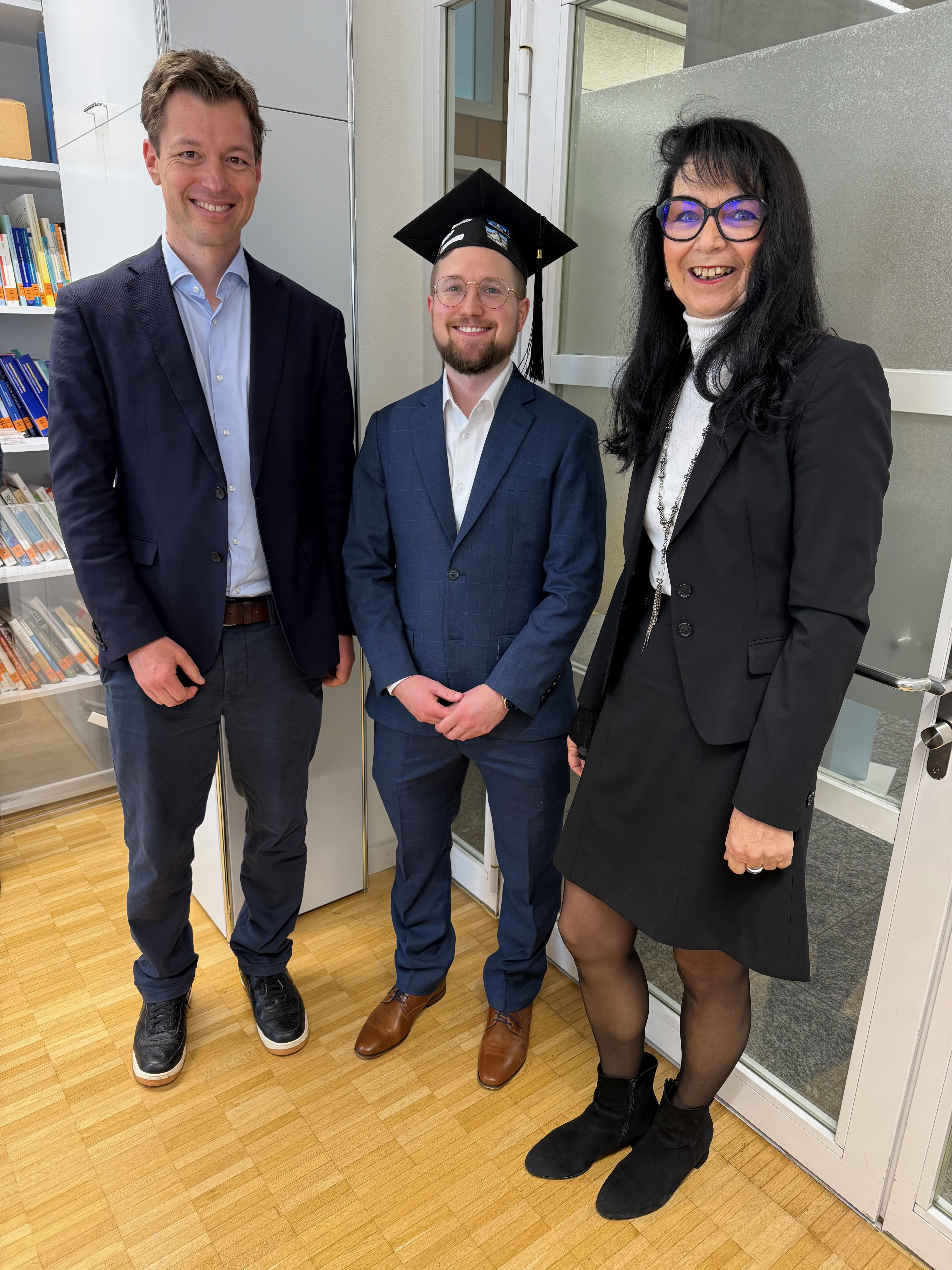
His dissertation is titled “The Interplay Between Education and Innovation: The Role of Occupational Choices and Skill Updating” and was supervised by Uschi Backes-Gellner and Samuel Mühlemann.
In his thesis, he investigates how education effectively provides the skills that are required for innovation. Specifically, he analyzes two channels through which individuals acquire the innovation-relevant skills
(1) the individual channel, e.g., individuals’ own educational and occupational choices
(2) the institutional channel, e.g., the frequent updating of educational and occupational programs, which ensures that innovation from the research and development (R&D) frontier finds its way back to education.
In the first chapter he sheds light on the untapped innovation potential of women as a key challenge to the relationship between education and innovation. Specifically, he studies how gender norms affect occupational choices and the underrepresentation of women in innovation. He shows that gender norms are directly and indirectly associated with fewer patents filed by women. More traditional gender norms in a region lead to a significantly lower number of patents filed by women. Additionally, more traditional gender norms lead to a negative indirect effect on innovation via occupational choices. Overall, he shows that the untapped innovation potential of women can be traced back to gender norms and that part of this effect arises from gender-biased occupational choices (get Working Paper).
While mobilizing untapped innovation potential of women constitutes one challenge, responding to new skill demands for green innovations presents another societal challenge. Thus, in the second chapter, he investigates how individuals’ occupational choices contribute to meeting the demand for green skills in the context of transforming a fossil-based economy into a green economy. Specifically, he analyzes how direct exposure to climate change shapes an individual’s aspiration for green occupations. He finds that individuals who were exposed to a natural disaster aspire to greener occupations especially when they also hold strong environmental awareness or optimism. Overall, these findings provide valuable insights for informing educational policy about measures that support the green energy transformation by increasing the green workforce.
The third chapter of his thesis shifts its focus to an important institutional channel supporting innovation and examines how curriculum updates change the skills that are contained in curricula. He specifically analyzes how the addition of new skills, the removal of old skills, and combinations thereof affect the labor market outcomes of VET graduates of updated curricula in comparison to previous curricula. Descriptive results show a large variation in updates regarding their novelty rate and removal rate, indicating that curriculum designers handle the trade-offs differently. Some add few new skills but heavily remove old skills, some add many new skills but remove hardly any old skills and all combinations thereof. Overall, updates with a sufficiently large removal of old skills are generally beneficial. This finding indicates that when a curriculum is updated to include new technologies or skills, it should be accompanied by a sufficient removal of old skills. The findings implicate that as innovation necessitates frequent additions of new skills in curricula, these updates also need to remove old skills to be able to increase labor market outcomes and productivity (get Publication).